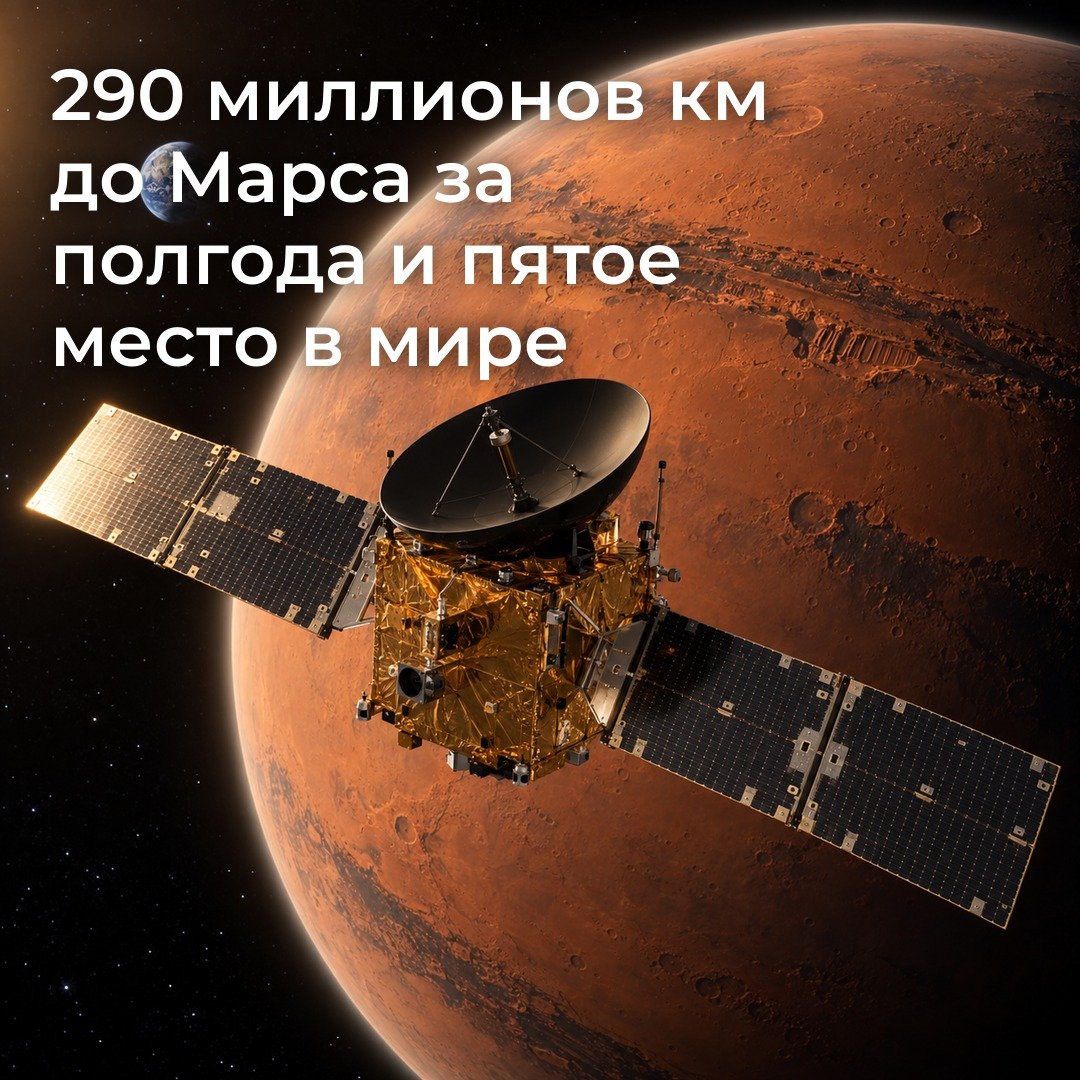
The UAE’s First Mission to Mars Took Six Months. Here Is How Al Amal Did It
When we talk about UAE innovation with the investors and buyers we work with, the conversation usually lands on skylines, free zones, or logistics corridors. Fewer people bring up a spacecraft. Yet in February 2021, the UAE became the fifth country in the world, and the first Arab nation, to reach Mars, and the story of how it got there says as much about national planning as any infrastructure project we track.
A launch timed to a deadline that could not move
Al Amal (the Hope Probe) launched in July 2020 from a spaceport in Japan. That detail alone is worth sitting with: a Gulf state without its own orbital launch capability built a Mars mission and put it on someone else’s rocket to hit a window that Mars orbital mechanics only opens every 26 months. Miss it, and the next attempt waits two years.
The target date was not arbitrary. Planners wanted the probe in Martian orbit by February 2021, matching the 50th anniversary of the unification of the seven emirates into the UAE. A scientific mission built around a national milestone is an unusual constraint to design engineering around, but it is also a useful lens on how the UAE approaches long-horizon projects generally: pick the deadline first, then build backward from it.
290 million kilometers, and no landing
Between launch and Mars orbit insertion, Al Amal covered roughly 290 million kilometers. It did not land. That is a deliberate design choice, not a limitation. Where a rover studies a single patch of ground in detail, Al Amal was built to orbit Mars for a full Martian year (about 687 Earth days) and observe the entire atmosphere at once, tracking weather patterns and seasonal change across the whole planet rather than one fixed location.
The distinction matters for anyone thinking about how the UAE positions itself scientifically. This was not a symbolic flag-plant. It was an atmospheric science mission designed to produce a continuous, planet-wide dataset that earlier Mars missions had not attempted in the same way.
Why this belongs in a conversation about the UAE, not just about space
We are not going to force a real-estate angle onto a Mars probe. But for readers trying to understand the country they are investing in, Al Amal is a data point about execution. A nation with no prior deep-space program committed to a fixed launch window, an unmovable arrival date, and a genuinely novel science objective, and delivered on all three. That same pattern of compressed timelines and hard deadlines shows up repeatedly in how the UAE builds infrastructure, regulation, and large projects on the ground.
How six years turned into a domestic space team
The mission was announced in 2014, which gave planners roughly six years to go from concept to launch. The Mohammed Bin Rashid Space Centre partnered with the University of Colorado Boulder, Arizona State University, and the University of California, Berkeley on instrument design, and used those partnerships to embed Emirati engineers in the engineering work from the start. By the time Al Amal reached Mars orbit, the team running the mission was overwhelmingly Emirati, a shift for a country that had no deep-space engineering base a decade earlier.
That sequencing, a hard target announced first, defined partnerships brought in for specific technical gaps, then the work handed to an in-house team, shows up again whenever the UAE builds a new regulatory framework or infrastructure category from scratch. The six-year runway was treated as enough time to build a capability domestically, and the plan still had to meet a launch window only weeks wide, fixed by orbital mechanics. For anyone assessing how the country executes on stated timelines, that combination, ambition paired with a hard external deadline, is the more useful signal than the mission itself. The probe’s raw data has also been made available to research institutions worldwide since the first year in orbit.
FAQ
When did the Hope Probe (Al Amal) launch?
July 2020, from a launch site in Japan.
When did it reach Mars?
February 2021, after traveling approximately 290 million kilometers, coinciding with the UAE’s Golden Jubilee (50th anniversary of unification).
Did Al Amal land on Mars?
No. It remains in orbit, observing the Martian atmosphere for a full Martian year rather than studying a single surface location.
Is the UAE the first Arab country to reach Mars?
Yes, and the fifth country worldwide to do so.
What makes Al Amal different from a Mars rover?
Rovers study the surface at one location. Al Amal orbits the planet and captures data on the atmosphere as a whole, including weather cycles across all Martian seasons.
Why does a real-estate advisory team cover a space mission?
Because understanding how a country executes on hard deadlines and long-horizon commitments, whether in orbit or on the ground, is part of understanding where it is headed next.